
Alan Simpson Net Worth 2026: The $1.5 Million Estimate Behind Wyoming’s Three-Term Senator
Alan simpson net worth was estimated at roughly $1.5 million, according to the online wealth trackers that follow former members of Congress. That figure was never confirmed by Simpson himself, and no audited record of his personal finances was ever published. It rests on a handful of weak biography sites that repeat one another, and this article treats it as an unverified online estimate — the best available answer, not a verified fact.
What makes the question interesting is not the size of the number. It is the shape of the life behind it. Simpson spent eighteen years in the United States Senate, a decade of them as the second-ranking Republican in the chamber, and then spent another quarter of a century as a teacher, a board member, a commission co-chairman and a working lawyer in Cody, Wyoming. He was the son of a governor and senator, the father of three, and the husband of Ann Simpson for more than seventy years. His wealth, whatever its exact size, was the accumulation of a lifetime of public salaries, not a business empire or a celebrity fortune.
Unlike the aggregator pages that copy one another’s guesses, this article separates what is documented from what is estimated. His birth date, his election results, his committee posts, his board service and his death are matters of public record. His bank balance, his investments and his property holdings are not. Where a number is an estimate, this article says so, names the source, and gives the range instead of a false precision. That discipline is the only honest way to answer a search for alan simpson net worth.
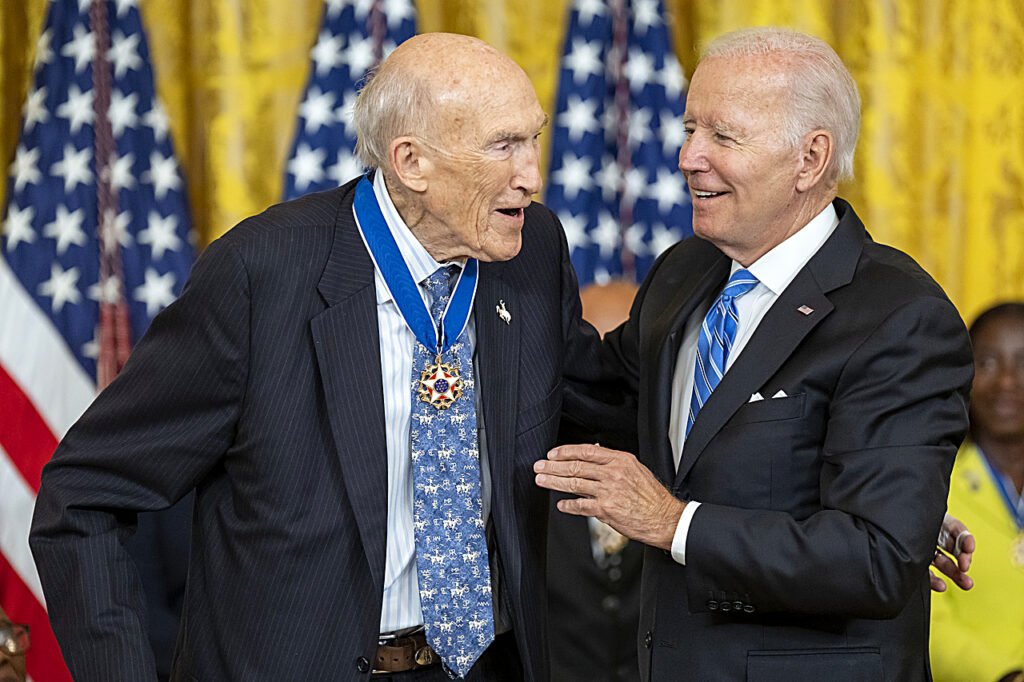
Table of Contents
Alan Simpson Net Worth: The Honest Estimate
The most responsible way to state alan simpson net worth is as a single hedged figure with a warning attached: about $1.5 million, according to the online estimators, and unverified. Several weak biography sites repeat the same number — MetaUnfolded puts it at $1.5 million, and Superstars Biography lists $1.5 million as of December 2024 — but they appear to be repeating one another rather than reporting independently. No reputable financial publication ever published an estimate of Simpson’s wealth, and he never disclosed his finances in an interview. Anyone quoting a precise number to the dollar is inventing certainty that does not exist.
That thin sourcing is itself part of the story. Simpson was a public servant from a small state, not a celebrity, and the wealth-tracking industry barely noticed him. The sites that did notice him are the low-authority biography aggregators that assign a dollar figure to almost every public figure, usually without showing their working. The $1.5 million figure is consistent across them, which is mildly reassuring, but consistency among sites that copy one another is not the same as confirmation. Readers searching for alan simpson net worth should treat the figure as the standing online estimate and nothing more.
There is one more reason to treat the number with care. Simpson’s career was spent entirely in public service and the law, two fields that pay comfortable salaries but rarely produce large fortunes. A man who spent thirty-one years in elected office, then taught at Harvard and sat on corporate boards, could plausibly have accumulated around $1.5 million in savings, property and investments by the end of a long life. The figure fits the shape of the career. It is not, however, a documented fact, and this article will not pretend otherwise.
Alan Simpson Quick Facts
| Detail | Information |
|---|---|
| Full name | Alan Kooi Simpson |
| Date of birth | September 2, 1931 |
| Birthplace | Denver, Colorado, United States |
| Date of death | March 14, 2025 |
| Place of death | Cody, Wyoming, United States |
| Age at death | 93 |
| Nationality | American |
| Profession | Politician, lawyer |
| Political party | Republican |
| Estimated net worth | Approximately $1.5 million, according to published online estimates (unverified) |
| Wyoming House of Representatives | Elected 1964, served until 1977 |
| United States Senate | January 1, 1979 – January 3, 1997 |
| Senate Republican Whip | 1985–1995 |
| Best known for | Simpson–Bowles deficit commission (2010); 1986 immigration reform |
| Highest honour | Presidential Medal of Freedom, 2022 |
| Education | University of Wyoming (BS 1954, JD 1958) |
| Military service | United States Army, Infantry, 1954–1956 |
| Spouse | Ann Schroll Simpson (married 1954) |
| Children | Three — Susan, William and Colin |
The biographical facts in this table are documented by the Biographical Directory of the United States Congress, Reuters and Simpson’s law-firm biography. The net-worth line is an estimate drawn from published online sources, not an official financial record.
Why the $1.5 Million Figure Is the Only One Worth Quoting
The case for the alan simpson net worth figure of about $1.5 million is not that it comes from a strong source. It is that it is the only figure with any consistency at all, and that it fits what is known about how Simpson earned his living. He drew a public salary for most of his working life — first as a lawyer and state legislator, then as a senator, then as a teacher and board member.
Public salaries accumulate slowly. A man who saved steadily, owned a home in a small Wyoming town, and lived to ninety-three could plausibly have left an estate of around $1.5 million. The figure is modest, unglamorous and believable, which is more than can be said for its rivals.
The figure also fits the spending side of his life. Simpson lived in Cody, Wyoming, a small town where a dollar went a long way, and he was famous for his plain tastes. He was not a collector of houses, cars or art, and no report ever described him living lavishly. His public appearances in later life were at universities, civic events and television studios, not at charity galas or on yachts. A fortune of $1.5 million is consistent with a man who earned well, spent modestly and saved the difference over seven decades.
Why the Bigger Figures Fail
Other numbers circulate for alan simpson net worth, and every one of them should be rejected. One page contradicts itself outright, giving $20 million in one place and $50 million in another — a clear sign that its numbers were invented rather than researched. Neither figure has any plausible connection to Simpson’s career. A senator who never founded a company, never sold a business and never held a high-paying private-sector job does not accumulate $20 million, let alone $50 million, from public salaries and board fees.
The $20 million figure looks like a number borrowed from a different kind of public figure — a businessperson or an entertainer — and pasted onto a politician’s biography by a site that never checked its work. The $50 million figure, appearing on the same page as the $20 million one, confirms that the page was not reporting anything at all. This article rejects both figures entirely. The honest answer remains the hedged $1.5 million, flagged as an unverified online estimate.
What Would Settle the Number
Nothing short of a disclosure from Simpson’s family or his estate would settle alan simpson net worth to a single verified figure. He never gave one, and there is no reason to expect one now. Unlike modern members of Congress, whose finances are partly visible through mandatory disclosure filings, Simpson left the Senate in 1997, before the current disclosure regime made such records routine, and he spent his later decades outside elected office. His estate was a private family matter, and it should be treated as one.
Readers searching for alan simpson net worth should therefore treat the $1.5 million figure as the answer, and treat any site that quotes a larger number as offering a guess dressed up as a fact. The rest of this article explains how the money was earned, what it was spent on, and why a modest fortune was the fitting result of a very large public life.
How Alan Simpson Made His Money
Alan simpson net worth was built the slow way for a public servant: a law practice, a legislative salary, a Senate salary, a pension, and then a long second act of teaching, board service and writing. He never founded a company, never sold a product line, and never became a television personality with a merchandise empire. His income came from work — legal work first, political work second, and advisory work third — and from the pension that a long public career earned him. Understanding alan simpson net worth means understanding that structure, because it explains both why the fortune was modest by celebrity standards and why it was real.
His income also sets him apart from the media figures whose fortunes are usually estimated the same way. A senator’s pay was public and fixed, while a journalist’s or presenter’s pay was negotiated in private — which is why a figure such as Barbara Starr net worth is estimated from a different kind of evidence altogether. Simpson’s money, by contrast, can be traced through the jobs he held, and this section follows that trail honestly, using only what is documented about his career.
The precise amount he earned from each source is not publicly confirmed, and this section does not invent pay figures for him. What it does is describe each income stream honestly, using only what is documented about his career and what is generally true of public-sector work.
1. The Law Practice — Cody, Wyoming
Simpson’s first income came from the law. After graduating from the University of Wyoming Law School in 1958 and being admitted to the Wyoming bar, he served briefly as an assistant attorney general of Wyoming in 1958–1959, then as city attorney of Cody from 1959 to 1969, and as a United States Commissioner from 1959 to 1969. Alongside those public posts he practised law in Cody, first in partnership with his father as Simpson & Simpson, and then in the firm of Simpson Kepler & Simpson from 1960 to 1978.
A small-town law practice in Wyoming in the 1960s and 1970s paid a solid professional living, not a fortune. Cody was then, as now, a small town, and its lawyers served ranchers, small businesses and local government rather than large corporations. The practice gave Simpson a steady income, a reputation in his community, and the local standing that later carried him into politics. It also gave him something more valuable than money: eighteen years of listening to ordinary people’s problems, which shaped the plainspoken style that later made him famous in Washington.
The law practice contributed to alan simpson net worth in the ordinary way a profession does — year by year, fee by fee — and it remained part of his life long after he left the Senate, when he returned to Cody and stayed a partner in the firm.
2. The Wyoming Legislature and the Senate Salary
Simpson’s second income stream was elected office. He was elected to the Wyoming House of Representatives in 1964 and served there until 1977, rising to Assistant Majority Leader, Majority Leader and Speaker Pro Tem. State legislative pay in Wyoming in that era was modest — a part-time citizen legislature, not a full-time professional one — and Simpson continued his law practice throughout. The legislature was a public service commitment, not a path to wealth.
The Senate was different. Simpson was elected to the United States Senate in November 1978, was appointed to the seat on January 1, 1979, and served until January 3, 1997 — eighteen years, three terms, and a decade of them as the Senate’s second-ranking Republican. A senator’s salary was set by statute and paid on a fixed schedule, and it rose slowly over his tenure. It was a comfortable professional income, far above the Wyoming average, but it was not the kind of money that builds a large fortune on its own.
What the Senate did give him was security: a steady pay cheque for eighteen years, and a federal pension when he retired. That pension, paid for the rest of his long life, was one of the most durable parts of his wealth, and it is one of the reasons the $1.5 million estimate is plausible even though his salaries were never large.
3. Board Service, Teaching and Writing
After leaving the Senate in 1997, Simpson’s income came from the portfolio of posts that senior former senators typically assemble. He served on the board of directors of the Biogen Corporation from 1997 to 2004, and on the board of American Express Funds, later RiverSource Funds, from 1997 to 2006. Corporate board fees for a former senator of his standing were meaningful — a useful supplement to his pension — but they were not the seven-figure annual packages that go to the directors of the largest companies. Biogen and RiverSource were substantial firms, yet Simpson was one director among many, serving for a fixed term, and his fees were a supplement rather than a fortune.
Teaching paid less but mattered more to him. From January 1997 to June 2000 he was a visiting lecturer at Harvard University’s Kennedy School of Government, based at the Shorenstein Center, and he served as Director of the Institute of Politics there from 1997 to 2000. He also lectured at the University of Wyoming, his alma mater, and spoke on television news programmes and at universities across the country. Academic posts pay modestly, and Simpson took them because he loved the work, not because they enriched him.
His book, Right in the Old Gazoo: A Lifetime of Scrapping with the Press, published by William Morrow in 1997, added a writer’s income — a memoir and critique of the press, written as he left the Senate, which drew on his famous clashes with journalists during the Bork and Clarence Thomas hearings. Royalties from a political memoir by a retired senator were real but modest, and they completed the picture of a man who earned his living from words and judgement rather than from capital.
4. Public Service After the Senate
Simpson’s final income stream was the least lucrative and the most characteristic: unpaid or modestly paid public service. He served as a commissioner of the American Battle Monuments Commission, and as co-chairman of the Continuity in Government Commission from 2002 to 2011. He was a member of the Iraq Study Group in 2006, the bipartisan panel led by James Baker and Lee Hamilton that reviewed American policy in Iraq. In 2010 he co-chaired the National Commission on Fiscal Responsibility and Reform with Erskine Bowles — the Simpson–Bowles commission — at the request of President Barack Obama.
None of these posts made him rich. All of them kept him at the centre of American public life for another fifteen years after he left the Senate, and all of them reflected the same choice he had made all his life: to earn his living in public service, and to let the fortune take care of itself.
Early Life and Education
Alan Kooi Simpson was born on September 2, 1931, in Denver, Colorado, and grew up in Cody, Wyoming, a small town at the eastern edge of Yellowstone country. He was the second son of one of Wyoming’s most prominent political families. His father, Milward Simpson, was a Wyoming governor and later a United States senator, and his mother, Loretta Kooi, gave him the middle name he carried all his life. Politics was the family business, and young Alan grew up inside it — attending events, meeting officeholders, and learning early that public life was a normal way to spend a working life.
Cody shaped him as much as his family did. It was a ranching and tourist town, plainspoken and sceptical of pretension, and Simpson kept its manners all his life. He attended Cody’s public schools, and he was, by his own later account and by the recollection of those who knew him, a boisterous and sometimes troublesome boy — an athlete, a prankster, and a young man who needed a firm hand. That roughness never quite left him, and it later became one of his trademarks in the Senate, where colleagues valued his candour even when they winced at his language.
His education followed the Wyoming path. He graduated from the University of Wyoming in 1954, then served in the United States Army, in the Infantry, from 1954 to 1956, including service in West Germany during the final years of the occupation. He returned to Laramie and graduated from the University of Wyoming Law School in 1958. In 1954, the same year he graduated from college, he married Ann Schroll, a marriage that lasted more than seventy years, until his death. The early years of alan simpson net worth were therefore the early years of a young lawyer in a small town: a new practice, a young family, and a modest income that grew slowly, in the ordinary way.
Career Journey
The career behind alan simpson net worth was long, concentrated and unusually stable. Most politicians spend years seeking their first steady office; Simpson found his in the Wyoming legislature and kept a public salary for the next thirty-one years. The journey below follows that path from a Cody law office to the Senate leadership and then to the deficit commission, and it explains why his wealth is best understood as the product of a lifetime of public salaries rather than a series of separate successes. For the full biographical record, see the Alan Simpson Wikipedia page.
1954–1964: Army, Law School and the Cody Practice
Simpson’s working life began with the Army and the law. He graduated from the University of Wyoming in 1954 and served in the Infantry until 1956, then returned to Laramie for law school, graduating in 1958. He was admitted to the Wyoming bar that year, served briefly as an assistant attorney general, and then settled in Cody as city attorney and as a partner in his father’s firm.
These were the foundation years: a young lawyer building a practice, raising a family with Ann, and becoming known in Park County as a capable and plainspoken man. Nothing about these years suggested a fortune in the making, and nothing about them needed to. They built the reputation that later carried him to Cheyenne and Washington.
1965–1977: The Wyoming House of Representatives
Simpson was elected to the Wyoming House of Representatives in 1964 and served there until 1977, rising through the leadership to Assistant Majority Leader, Majority Leader and Speaker Pro Tem. Thirteen years in a citizen legislature taught him the craft of legislating: how to count votes, how to negotiate with opponents, and how to explain an unpopular decision to voters back home. It also taught him patience. Wyoming’s legislature met briefly, and its members returned to their ordinary jobs between sessions. Simpson kept his law practice throughout, and the two occupations reinforced each other — the lawyer’s precision and the legislator’s judgement, both grounded in the same small community.
1979–1997: Three Terms in the United States Senate
In November 1978 Simpson was elected to the United States Senate, and he was appointed to the seat on January 1, 1979, filling the vacancy left by the resignation of Senator Clifford P. Hansen. He was sworn in on New Year’s Eve 1978 in Cody, and he served until January 3, 1997, winning re-election in 1984 and 1990 and choosing not to seek re-election in 1996. Eighteen years in the Senate made him one of Wyoming’s longest-serving senators, and his tenure covered the presidencies of Carter, Reagan, George H. W. Bush and Clinton.
His committee work was substantial. He chaired the Senate Committee on Veterans’ Affairs in the 104th Congress, chaired the Judiciary Committee’s Subcommittee on Immigration and Refugee Policy from 1980 to 1984, chaired the Subcommittee on Social Security, and served on the Finance Committee from 1994 to 1996. He was, in short, a working senator rather than a show senator — a man whose influence came from the rooms where legislation was written, not from the television studios where it was debated.
1985–1995: Senate Republican Whip
From 1985 to 1995 Simpson served as the Senate Republican Whip, the second-ranking position in the Republican leadership. For a decade he was the man who counted the votes, kept the caucus together, and delivered the hard news to colleagues who did not want to hear it. The job made him one of the most powerful figures in the Senate, and it also made him one of the most quotable. He was a blunt talker who was not afraid to promote unpopular causes in his own party, including abortion rights and gay equality, and he remained for years a part of the Republican establishment even as he disagreed with it in public.
His chief legislative legacy was the overhaul of the immigration laws that President Ronald Reagan signed in 1986 — the Immigration Reform and Control Act, known as Simpson–Mazzoli after its Senate and House sponsors. It was the last comprehensive immigration reform to become law, and it remained the reference point for every later debate on the subject. That single achievement would have justified a Senate career. Simpson’s had several more.
1997–2010: Harvard, the Iraq Study Group and the Return to Cody
Simpson left the Senate in January 1997 and went, characteristically, to teach. He spent three years at Harvard’s Kennedy School as a visiting lecturer and Director of the Institute of Politics, then returned to Cody, where he stayed a partner in his law firm, sat on the board of the Buffalo Bill Center of the West, and lectured at the University of Wyoming.
He served on the Iraq Study Group in 2006, and he remained a frequent presence on television news programmes, where his candour and humour made him a favourite guest. These were not the years of a man winding down. They were the years of a man who had traded power for influence, and who seemed to enjoy the trade.
2010: The Simpson–Bowles Commission
In February 2010 President Barack Obama created the National Commission on Fiscal Responsibility and Reform by executive order and asked Simpson to co-chair it with Erskine Bowles, President Clinton’s former chief of staff. The commission’s task was to propose a plan to reduce the federal deficit, and its co-chairs released their report, The Moment of Truth, on December 1, 2010. The plan proposed reducing the deficit by nearly $4 trillion over a decade through a mix of spending cuts and tax reform.
On December 3 the commission voted 11–7 in favour of the plan — three votes short of the fourteen needed to send it to Congress for a vote. The plan was never adopted, and Congress never voted on it. The commission added nothing to alan simpson net worth — it was unpaid public service — but it defined his legacy. The commission’s failure was a disappointment to both co-chairs, and it became the defining episode of Simpson’s later life: the moment when the most bipartisan, most serious deficit plan in a generation fell short by three votes, and the country went on borrowing instead.
2022–2025: The Medal of Freedom and Death
In July 2022 Simpson received the Presidential Medal of Freedom from President Joe Biden, the highest civilian honour in the United States, for his years of public service and statesmanship. He was ninety years old, and the ceremony at the White House was a rare moment of agreement in a divided capital: a Democratic president honouring a Republican senator for a lifetime of service across party lines. Simpson wore the medal with a Wyoming touch — a bucking-horse pin on his lapel — and he accepted it as he had accepted everything else in his career, with a joke and a shrug.
He spent his final years in Cody, with Ann and his family, still speaking, still writing, still offering opinions that nobody had asked for and everybody quoted. He broke his hip in December 2024 and never fully recovered. He died on March 14, 2025, in Cody, Wyoming, at the age of ninety-three, surrounded by family and friends. His memorial service was held at the University of Wyoming in Laramie, the institution that had shaped him and that he had served all his life.
Major Achievements
Simpson’s achievements explain why the conversation about alan simpson net worth exists at all. A senator who serves eighteen years and leaves no great law behind him is a footnote; a senator who reforms the immigration system, leads his party’s caucus for a decade, and then co-chairs the most serious deficit commission in a generation is a figure of lasting importance. The achievements below are the documented milestones of that career, stated without exaggeration.
The first achievement was the Whip’s office itself. Serving as the Senate Republican Whip from 1985 to 1995 — a decade as the second-ranking Republican in the chamber — was a competitive achievement in its own right. The post required the trust of colleagues who disagreed with one another, and Simpson held it through three presidents, two changes of majority, and countless close votes. It is the reason his name still appears in histories of the Senate, and it is the foundation of his public reputation.
The second achievement was the 1986 immigration reform. The Immigration Reform and Control Act, which Simpson co-sponsored and steered through the Senate, overhauled the immigration laws and remains the last comprehensive immigration reform to become law. It was a compromise in the old sense of the word — neither side got everything it wanted, and both sides could claim something — and it demonstrated what Simpson did best: taking a divisive issue, finding the votes, and getting a bill signed.
The third achievement was the Simpson–Bowles commission. The deficit plan that Simpson and Erskine Bowles produced in December 2010 was the most detailed and most bipartisan attempt to put the federal budget on a sustainable path in a generation. It failed by three votes, but its ideas — a mix of spending restraint and tax reform, presented honestly and without partisan trimming — shaped every serious budget debate that followed.
It also showed why alan simpson net worth stayed modest: Simpson spent his seventies on unpaid public service rather than on paid private work. That a Republican from Wyoming and a Democrat from North Carolina could agree on a plan at all was, in the politics of 2010, an achievement in itself.
The fourth achievement was the Presidential Medal of Freedom in 2022. The award recognised a lifetime of public service and statesmanship, and it placed Simpson in the company of the most honoured Americans of his generation. It was presented by a president of the opposite party, which was fitting: Simpson’s career had been built on the belief that the other party was the opposition, not the enemy, and the medal was the country’s way of saying that belief mattered.
The fifth achievement was his book. Right in the Old Gazoo, published as he left the Senate in 1997, was a memoir and a critique of the press, written by a man who had spent eighteen years sparring with reporters and had enjoyed almost every minute of it. It was not a bestseller, and it did not make him rich, but it captured his voice — blunt, funny and unapologetic — better than any speech he ever gave, and it remains the best introduction to the man behind the office.
There were no business empires on his record — no company founded, no product sold, no fortune built outside public service — and this article does not invent any. His achievements were the quieter kind: a long run in the Senate, a landmark law, a serious deficit plan, and a medal for a lifetime of service. For a boy from Cody, Wyoming, that was already a substantial career.
Assets and Lifestyle
There is little publicly documented about the assets behind alan simpson net worth, and that absence is itself informative. Senators of Simpson’s generation did not accumulate visible assets the way modern celebrities do — no property empires, no car collections, no businesses with their names on the door. What can be said is that his wealth, such as it was, consisted of the ordinary assets of a long professional life: a home in Cody, savings accumulated over decades of public salaries, a federal pension, and the modest returns on a lifetime of steady saving.
His lifestyle, as far as it is visible, was modest. He lived in Cody, a small town where a dollar went far, and he was famous for his plain tastes — a lawyer’s suits, a cowboy’s boots, and a bucking-horse pin on his lapel. He did not collect houses or cars, and no report ever described him living lavishly. His public appearances in later life were at universities, civic events and television studios, not at charity galas or on yachts.
That modesty is consistent with the estimated figure for alan simpson net worth. A fortune of $1.5 million, held by a man of ninety-three in a small Wyoming town, is substantial — but it is not the kind of money that buys mansions or fleets of cars, and it is best protected by not spending it.
Board service added a modest supplement to his income, not a fortune. The fees he earned as a director of Biogen and of American Express Funds were real money, but they were a long way from the packages that go to the directors of the largest companies — a contrast with business leaders whose wealth was built in the boardroom rather than the Senate chamber, such as Bill Ford, whose fortune came from a very different kind of career. Simpson’s boards were a supplement to a pension, not a second fortune, and they fit the pattern of his whole financial life: comfortable, respectable, and far from spectacular.
One more asset deserves mention, even though it cannot be valued: his pension. Eighteen years in the Senate earned Simpson a federal pension that was paid for the rest of his long life — nearly three decades of retirement. That pension, more than any single sum, was the foundation of his financial security in old age. It was the kind of income that most Americans do not have, and it is one of the most durable parts of his wealth. A man who could count on a pension cheque every month for twenty-eight years did not need a large fortune to live comfortably, and Simpson’s $1.5 million estimate should be read with that pension beside it.
Alan Simpson’s Financial Setbacks
Most net-worth articles have a dramatic setbacks section — a fraud case, a bankruptcy, a divorce. Alan simpson net worth has no such story, and that is worth stating plainly rather than inventing one. There is no public record of Simpson losing money to fraud, no lawsuit, no bankruptcy, no failed business venture and no expensive divorce. He was married once, for more than seventy years, and he never ran a company. The absence of a financial disaster is not a gap in the research; it is the research result.
That does not mean his financial path was free of cost. The first cost was the choice of public service itself. A lawyer of Simpson’s ability, with his connections and his reputation, could have earned far more in private practice in Denver or Washington than he ever earned in the Senate. He chose the Senate instead, and he chose to stay there for eighteen years. The difference between what he earned and what he might have earned is the largest financial sacrifice of his life, and it was entirely voluntary. It is also the reason alan simpson net worth stayed near $1.5 million rather than growing ten times larger.
The second cost was the Simpson–Bowles failure. The deficit plan that Simpson co-chaired in 2010 was never adopted, and the country went on borrowing. That was a policy failure, not a personal financial loss — Simpson was paid nothing extra for the commission, and he lost nothing when it failed — but it was a setback of a different kind. He had spent a year of his late seventies on a plan he believed would save the country money, and it fell three votes short. The frustration of that failure stayed with him for the rest of his life, and he returned to it in speeches and interviews for years afterwards.
The third cost was the simplest: time. Simpson lived to ninety-three, and a long retirement costs money. Twenty-eight years of retirement, however modest the lifestyle, draw down savings steadily, and the $1.5 million figure should be read as the remainder of a lifetime of accumulation after nearly three decades of spending it down. His pension softened that cost, but it did not remove it.
None of this amounts to a financial setback in the usual sense. It amounts to a modest fortune that was built slowly, protected by a pension and a modest lifestyle, and spent down gently over a long retirement. That is a far better position than most former politicians find themselves in, and it is the honest version of this section.
Personal Life
Simpson’s personal life was, by the standards of modern politics, remarkably stable and remarkably private. He married Ann Schroll in 1954, the year he graduated from the University of Wyoming, and the marriage lasted more than seventy years, until his death in 2025. They had three children — Susan, William and Colin — and several grandchildren. At his memorial service, speakers described Ann as his greatest achievement and his partner of a lifetime, and Simpson himself had often said the same thing in plainer language.
A marriage of seventy years is, by any measure, the most successful partnership of his life, and it was also the most financially sensible: one household, one set of expenses, and no divorce to divide what he had built.
He was, by every account, a large and boisterous presence — six feet seven inches tall, balding, loud, funny, and incapable of whispering an opinion. Reuters called him “a six-foot, seven-inch balding giant”, and the description fit. He was famous for his one-liners, his candour, and his willingness to say in public what his colleagues would only say in private. That bluntness sometimes got him into trouble, and he apologised when it did, but it was also the reason people trusted him: nobody ever wondered what Alan Simpson really thought.
His friendships crossed party lines in a way that is rare in modern politics. He was close to Ted Kennedy, his great adversary on the Senate floor, and the two men maintained a friendship that survived decades of disagreement. He worked easily with Democrats, and he was as comfortable with Erskine Bowles, a Clinton Democrat, as he was with his own Republican colleagues. That capacity for friendship across the aisle was not a political tactic. It was his character, and it was the reason the Simpson–Bowles commission was possible at all. It was worth more to him than anything counted in alan simpson net worth.
In Cody he was a neighbour before he was a senator. He stayed a partner in his law firm, served on local boards, lectured at the University of Wyoming, and turned up at civic events where nobody introduced him as a former whip. He enjoyed hobnobbing around town with Ann, as one Wyoming obituary put it, and he treated Cody as home in a way that Washington never was. For readers interested in the financial side of that life, the discussion of alan simpson net worth in this article is built entirely from public sources, and it respects the privacy he chose.

Alan Simpson Net Worth Growth Timeline
No audited year-by-year record of alan simpson net worth exists, and this article will not invent one. The fabricated tables that some aggregator sites publish — precise dollar figures for every year of a public figure’s life — are fiction, and they should not be trusted wherever they appear. What follows instead is a qualitative timeline: the documented events that built his wealth, in order, without invented numbers.
His story begins in 1931, when he was born in Denver and raised in Cody, the son of a future governor and senator. The early years earned nothing, but they gave him the family name and the small-town grounding that later carried him into office. He graduated from the University of Wyoming in 1954, served in the Army until 1956, and graduated from law school in 1958. Those years built the skill that would later pay: a law degree, a bar admission, and a practice in his hometown.
The first real income came in the late 1950s, with his work as an assistant attorney general, as Cody’s city attorney, and as a partner in his father’s law firm. It was a modest professional income, and it grew slowly through the 1960s as his practice and his reputation grew together. His election to the Wyoming House in 1964 added a legislator’s pay to a lawyer’s income, but the legislature was part-time, and the law remained his living.
The years from 1979 to 1997 were the wealth-building years. Eighteen years in the United States Senate, a decade of them as Republican Whip, provided a steady and rising salary, and each year of service added to the pension he would draw in retirement. These were the years when alan simpson net worth grew most quickly — not because the salary was large, but because it was steady, and because a man who saved a portion of a steady salary for eighteen years ends up with a meaningful sum.
The next chapter began in 1997, when he left the Senate and went to Harvard. The years from 1997 to 2010 added board fees from Biogen and American Express Funds, teaching income from Harvard and the University of Wyoming, and royalties from his book. Each stream was modest on its own, and together they replaced only part of his Senate salary. His wealth, during these years, grew slowly if at all — and that was the point. He had traded income for influence, and he seemed content with the exchange. Anyone wondering how a public servant’s pension and savings build up over decades can try a net worth calculator to see how steady income compounds year after year.
The final chapter ran from 2010 to 2025. The Simpson–Bowles commission paid him nothing and cost him a year of his late seventies. The Medal of Freedom in 2022 paid him nothing at all. Neither honour added a dollar to alan simpson net worth, and he would not have wanted them to. His income in these years was his pension, his savings, and the occasional speaking fee. His wealth was, for the last fifteen years of his life, in a gentle decline — drawn down slowly by the ordinary costs of a long retirement in a small town.
When he died in March 2025, at ninety-three, the $1.5 million estimate was the remainder of a lifetime of public salaries, carefully saved and modestly spent.
Interesting Facts About Alan Simpson’s Wealth
The most interesting fact about alan simpson net worth is how small it was compared with the size of his career. He spent a decade as the second-ranking Republican in the United States Senate, chaired major committees, reformed the immigration laws, and co-chaired the most serious deficit commission in a generation — and he died with an estimated $1.5 million. In modern American politics, where senators routinely leave office as multi-millionaires, Simpson’s modest fortune is itself a statement: he went to Washington to legislate, not to enrich himself, and the size of his estate proves it.
Another interesting fact is the height. Simpson stood six feet seven inches tall, and his size was part of his political identity — colleagues joked that he was the only senator you could see over a crowd, and he used his height, and his booming voice, to dominate a room without raising it. A man that tall, with that voice, did not need to shout to be heard, and he rarely did. His physical presence was the opposite of his fortune: enormous where the money was modest.
A third fact is the candlelight swearing-in. Simpson was sworn into the Senate on New Year’s Eve 1978, in Cody, Wyoming, by candlelight — a small-town ceremony for a man who never forgot where he came from. He was appointed to the seat on January 1, 1979, and he served for eighteen years, but he always dated his Senate career from that candlelit evening in Cody, not from a ceremony in Washington. That evening began the Senate career behind alan simpson net worth.
A fourth fact is the friendship with Ted Kennedy. Simpson and Kennedy were adversaries on the Senate floor for years — a Wyoming Republican and a Massachusetts Democrat, divided on almost everything — and they were close friends off it. Their friendship was one of the most famous bipartisan relationships in the Senate, and it was built on the same quality that marked Simpson’s whole career: the belief that a political opponent was not a personal enemy. That belief later made the Simpson–Bowles commission possible, and it is one of the reasons his name is still spoken with respect in both parties.
A fifth fact is the book’s title. Right in the Old Gazoo was Simpson’s own phrase for the press — a Wyoming expression, half affectionate and half exasperated, for the institution he had spent a lifetime sparring with. The book was his farewell to the Senate and his verdict on the journalists who had covered him: combative, funny, and, in the end, fond. It was the work of a man who had enjoyed the fight and missed it already.
A sixth fact is the bucking-horse pin. When Simpson received the Presidential Medal of Freedom in July 2022, he wore a small bucking-horse pin on his lapel — the symbol of Wyoming, and of the University of Wyoming, where he had studied and taught. It was a deliberate choice, and it said everything about the man: a senator who had spent eighteen years in Washington and had never stopped being a boy from Cody. That pin, worth nothing, was the most valuable thing he wore that day — and it is a fitting emblem for alan simpson net worth, a fortune measured not in dollars but in the regard of his state and his country.
FAQs
What was Alan Simpson’s net worth?
Alan simpson net worth was estimated at roughly $1.5 million, according to the online wealth trackers that follow former members of Congress. MetaUnfolded and Superstars Biography both give the same figure, but they are weak sources that appear to repeat one another, and no audited or official figure was ever published. The $1.5 million should be read as an unverified online estimate, not a confirmed fact.
How did Alan Simpson make his money?
Simpson made his money from public service and the law. He practised law in Cody, Wyoming, served thirteen years in the Wyoming House of Representatives, and then spent eighteen years in the United States Senate, where he drew a fixed public salary and earned a federal pension. After leaving the Senate he added board fees from Biogen and American Express Funds, teaching income from Harvard and the University of Wyoming, and royalties from his 1997 book, Right in the Old Gazoo. He never founded a company or held a high-paying private-sector job.
When did Alan Simpson die?
Alan Simpson died on March 14, 2025, in Cody, Wyoming, at the age of ninety-three. He had broken his hip in December 2024 and never fully recovered. He was surrounded by family and friends. His memorial service was held at the University of Wyoming in Laramie, his alma mater. His death fixed the story of alan simpson net worth in its final form: the estimate now describes a completed life, not a fortune still growing.
How long did Alan Simpson serve in the Senate?
Simpson served in the United States Senate from January 1, 1979, to January 3, 1997 — eighteen years across three terms. He was elected in November 1978, re-elected in 1984 and 1990, and chose not to seek re-election in 1996. From 1985 to 1995 he served as the Senate Republican Whip, the second-ranking Republican in the chamber. Those eighteen years were the main engine of alan simpson net worth, and the pension they earned him supported him for the twenty-eight years that followed.
What was the Simpson–Bowles commission?
The Simpson–Bowles commission was the National Commission on Fiscal Responsibility and Reform, created by President Barack Obama in February 2010 and co-chaired by Alan Simpson and Erskine Bowles. Its report, The Moment of Truth, released on December 1, 2010, proposed reducing the federal deficit by nearly $4 trillion over a decade. The commission voted 11–7 in favour of the plan, three votes short of the fourteen needed to send it to Congress, and the plan was never adopted.
Was Alan Simpson a millionaire?
On the published estimates, yes — just barely. Alan simpson net worth was estimated at about $1.5 million, which would make him a millionaire, but the figure is an unverified online estimate from weak sources, and no official record confirms it. What is certain is that his fortune was modest by the standards of modern American politics, and that it was built from public salaries rather than from business or celebrity income.
What was Alan Simpson’s biggest legislative achievement?
His chief legislative legacy was the Immigration Reform and Control Act of 1986, known as Simpson–Mazzoli, which overhauled the immigration laws and was signed by President Ronald Reagan. It remains the last comprehensive immigration reform to become law. His later work on the Simpson–Bowles deficit commission was his most famous post-Senate achievement, even though the plan was never adopted. Both achievements came from the same Senate career that built alan simpson net worth, and neither of them enriched him.
Did Alan Simpson win the Presidential Medal of Freedom?
Yes. Simpson received the Presidential Medal of Freedom in July 2022 from President Joe Biden, for his years of public service and statesmanship. He was ninety years old at the time. The award was presented by a Democratic president to a Republican senator, which was fitting for a man whose career had been built on working across party lines. The medal added honour, not money, to alan simpson net worth.
Who was Alan Simpson’s father?
Simpson’s father was Milward Simpson, a Wyoming governor and later a United States senator. Alan was the second son of one of Wyoming’s most prominent political families, and he followed his father’s path from the Wyoming legislature to the United States Senate. He practised law in partnership with his father in Cody before entering politics himself. The family name opened doors, but alan simpson net worth was built by his own thirty-one years in elected office.
Was Alan Simpson married?
Yes. Simpson married Ann Schroll in 1954, the year he graduated from the University of Wyoming, and the marriage lasted more than seventy years, until his death in 2025. They had three children — Susan, William and Colin — and several grandchildren. At his memorial service, speakers described Ann as his greatest achievement. That stability also helped protect alan simpson net worth across seven decades of shared expenses.
Why do different sites give different figures for his net worth?
Because no official figure for alan simpson net worth exists, every published number is an estimate built from assumptions about his pay, his pension, his board fees and his spending. Different trackers make different assumptions, so they reach different totals — and at least one page contradicts itself, giving $20 million in one place and $50 million in another. The $1.5 million figure is the only one with any consistency across sources, which is why this article uses it, hedged as an unverified estimate.
What did Alan Simpson do after leaving the Senate?
After leaving the Senate in January 1997, Simpson taught at Harvard’s Kennedy School of Government, where he was a visiting lecturer and Director of the Institute of Politics until 2000, and lectured at the University of Wyoming. He served on the boards of Biogen and American Express Funds, sat on the American Battle Monuments Commission, co-chaired the Continuity in Government Commission, served on the Iraq Study Group in 2006, and co-chaired the Simpson–Bowles deficit commission in 2010. He also wrote a book and remained a partner in his Cody law firm. Those posts added modestly to alan simpson net worth through board fees and teaching pay, and none of them made him rich.
Final Takeaway
Alan simpson net worth is best understood as a modest figure — roughly $1.5 million, unverified — built on a lifetime of public salaries and protected by a pension, a modest lifestyle and a marriage of more than seventy years. His fortune was not the product of a business empire, a celebrity career or a single windfall. It was the accumulated result of a law practice in Cody, thirteen years in the Wyoming legislature, eighteen years in the United States Senate, and a long second act of teaching, board service and public commissions. That is a modest fortune by the standards of modern American politics, and it is a real one.
The more interesting story is what the money did not buy. Simpson never traded his office for wealth, never founded a company on his connections, and never lived lavishly on the reputation he had earned. He went to Washington to legislate, and he came home to Cody to practise law, teach, and sit on local boards. The wealth he accumulated gave him the freedom to keep serving long after he left office — on commissions, in classrooms, and in the public debates he never tired of joining — and that freedom, more than any number, is the measure of his success.
Whether history remembers him for the immigration reform of 1986, for the Simpson–Bowles plan that fell three votes short, or for the Medal of Freedom he received at ninety, the foundation behind alan simpson net worth is already in place: a respected eighteen-year run in the Senate, a decade as his party’s whip, and a reputation for candour and bipartisanship that outlived him. His net worth was never large. His standing was, and it remains.
To explore more articles and updates about net worth and financial guides, feel free to check our Home Page.

Pingback: Bob Ley Net Worth 2026: The Honest $100K–$16M Range Behind ESPN's Longest-Serving Anchor - worthlino