
Brett Livingstone Strong Net Worth
Brett livingstone strong net worth has no reliable, verified published figure, and that honest answer is the right place to start. Unlike many celebrities whose fortunes are tracked by major wealth publications, the Australian-born sculptor and painter has never been the subject of a credible, sourced net worth estimate from a publication such as Forbes or Celebrity Net Worth, and no probate record, company filing, or personal disclosure puts a trustworthy total on his wealth.
What does exist is a paper trail of very large individual art sales, a bankruptcy filing, and one spectacular but fiercely disputed valuation claim, and those three strands pull in opposite directions. Any article that gave you a single neat number for brett livingstone strong net worth in 2026 without explaining that tension would be guessing, and this article will not do that.
What makes brett livingstone strong net worth such a fascinating question is the scale of the numbers attached to his name. He reportedly sold a portrait of Michael Jackson for $2.1 million in 1990, a figure described at the time as a record for a living artist’s portrait. He reportedly sold a carving of John Wayne’s face, cut from a Malibu boulder, for $1.13 million.
Decades later, a collection of Michael Jackson’s own artwork connected to him was described in press coverage as being valued at $900 million, a claim that was immediately contested. Add a proposed Los Angeles monument with a budget measured in billions, and it is easy to see why readers wonder whether brett livingstone strong net worth runs into the tens of millions, or far beyond. The truth, as this article will show, is more complicated, more interesting, and much less certain than any single figure suggests.
This article looks at brett livingstone strong net worth in full context. It separates documented sales from disputed claims, explains how a monumental sculptor actually earns money, and examines the bankruptcy that sits in the middle of his story. It also explains why project budgets are not personal wealth, and why an artwork’s asking price or appraised value is not cash in the bank. Nothing here is financial advice, and nothing here should be read as a claim about private bank accounts, property, or investments that have never been made public.
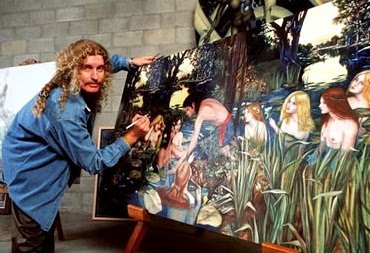
Table of Contents
Who Is Brett Livingstone Strong?
Brett-Livingstone Strong, born on 31 October 1953 in Junee, New South Wales, Australia, and raised in Sydney, is an Australian-born artist, sculptor, painter, and architect best known for monumental sculptures and portraits of Hollywood celebrities. His official gallery describes him as a child prodigy who was selling out exhibitions from the age of four, and by the time he was 18 he was exhibiting alongside the work of the celebrated British modernist Sir Henry Moore at the Fine Arts Museum of New South Wales.
That early start matters when thinking about brett livingstone strong net worth, because his earning life did not begin with a single breakthrough in middle age. It began in childhood and stretched, with dramatic ups and downs, across more than half a century.
Strong’s name is most closely associated with three things. The first is scale: he works big, carving faces into boulders, casting life-size bronzes, and designing monuments intended to rival the Statue of Liberty. The second is celebrity: his subjects and patrons have included John Wayne, John Lennon, Michael Jackson, Prince Charles, Princess Diana, Muhammad Ali, Elizabeth Taylor, and Rupert Murdoch, among others.
The third is ambition: his long-running City of Angels Monument project for Los Angeles, first proposed in the late 1990s, has been described at various times as a $3.6 billion development and, more recently, as a $2.4 billion structure, figures that describe a project’s cost rather than one man’s bank balance. Understanding brett livingstone strong net worth means keeping those three threads distinct: the art, the fame, and the monument budgets are related, but they are not the same thing.
Strong is also, since October 2009, a knight of the Imperial Orders of Constantine the Great and Saint Helen, an honour reportedly bestowed after a nomination by Debbie Rowe, a former wife of Michael Jackson, in recognition of his charitable work for children. He is therefore often styled Sir Brett-Livingstone Strong in recent coverage.
Quick Facts
| Detail | Information |
|---|---|
| Full name | Brett-Livingstone Strong (also written Brett Livingstone Strong) |
| Known as | Sir Brett-Livingstone Strong |
| Born | 31 October 1953, Junee, New South Wales, Australia |
| Raised | Sydney, Australia |
| Nationality | Australian-born; later based in the United States |
| Occupation | Artist, sculptor, painter, architect |
| Best known for | John Wayne boulder carving; life-size bronze John Lennon statue “Imagine”; Michael Jackson portrait “The Book”; City of Angels Monument |
| Child prodigy | Reportedly selling out exhibitions from the age of four |
| Major early honour | 1972 exhibition at the Fine Arts Museum of New South Wales alongside Sir Henry Moore, aged 18 |
| Royal commission | 1973 fine art invitation for Queen Elizabeth II’s Royal Opening of the Sydney Opera House |
| United States move | 1977, on a globe-spanning exhibition sponsored by the Australian Art Council and Trade Commission |
| Famous sale 1 | John Wayne boulder carving, reportedly sold for $1.13 million |
| Famous sale 2 | Michael Jackson portrait “The Book”, reportedly sold for $2.1 million in 1990 |
| Long-term partnership | The Jackson-Strong Alliance with Michael Jackson, formed in 1989 |
| Public commissions | United States Constitution Bicentennial Monument (dedicated 1987); NASA National Space Exploration Monument for the Smithsonian; 1984 Los Angeles Olympics and 2000 Sydney Olympics works |
| Major setback | Chapter 11 bankruptcy protection filed in 2005, linked to the City of Angels Monument project |
| Knighthood | October 2009, Imperial Orders of Constantine the Great and Saint Helen, for charitable work for children |
| Current project | City of Angels Monument, Los Angeles, with a planned unveiling on 4 September 2031 |
| Published net worth estimate | None verified from a credible wealth publication; see the full discussion below |
| Category | Net Worth, Artist |
Early Life
Brett Livingstone Strong was born in Junee, a country town in New South Wales, and raised in Sydney. The accounts of his childhood consistently describe an unusually early talent. His official gallery states that he was a child prodigy from the age of four who routinely sold out exhibitions early in life, and that framing is important: in the art world, a prodigy who sells work as a child is not simply a curiosity.
He is already a working professional, learning the commercial side of art — pricing, patrons, exhibitions — at an age when most children are still learning to read. For readers tracing brett livingstone strong net worth back to its roots, this is where the story begins, not with a lottery-style windfall but with decades of selling work.
One of his earliest surviving works underlines that point. His “1967 Tribute to Marilyn in Red,” a portrait of Marilyn Monroe in acrylic and oil on canvas, was created when he was still a teenager and was first exhibited in Sydney in 1968. Recent promotional material for the work describes the original, measuring 66 by 54 inches, as having been appraised at $20 million in 2025.
That appraisal figure should be treated with care: it comes from the artist’s own promotional channels rather than an independent auction result, and an appraisal is not a sale. Still, the work itself is well documented, and its history shows how early Strong attached himself to celebrity iconography, a theme that would define his entire career and, in turn, brett livingstone strong net worth discussions for decades.
By 1972, at just 18, Strong had an exhibition of painting and sculpture at the Fine Arts Museum of New South Wales alongside the work of Sir Henry Moore, one of the most respected sculptors of the twentieth century. The following year, in 1973, he received the high-profile commission to paint the fine art invitation for Queen Elizabeth II’s Royal Opening of the Sydney Opera House. These were not the achievements of a struggling unknown. They were national-level recognitions, and they help explain why, when Strong later arrived in the United States, he was able to command attention and high prices relatively quickly. He did not arrive as a beginner hoping for discovery; he arrived with a record.
After rigorous academic training in architecture, Strong left Australia in 1977, on a celebrated globe-spanning exhibition of his work, sponsored by the Australian Art Council and Trade Commission. The architectural training is a detail worth pausing on, because it shaped everything that followed.
Strong was not only a painter or a sculptor of busts and portraits. He thought in terms of structures, monuments, and public space, and that way of thinking led him toward the enormous civic projects — and the enormous budgets — that dominate the later chapters of his story. It also meant that his income would come from a mix of sources that is unusual even among successful artists: private portrait commissions, public monuments, limited editions, album and stage designs, and architectural work, rather than gallery sales alone.
During the United States leg of that 1977 exhibition, in San Francisco and Beverly Hills, Strong was reportedly approached by Gianni Versace and his associates, including Andy Warhol, who praised his talent. Warhol and Strong later became friends. Those circles, where art, celebrity, and money overlapped, became his market, and that market is the foundation of any serious discussion of brett livingstone strong net worth.
Art Career and Major Works
Strong’s American debut is one of the great art-world stories, and it is worth telling in detail because it set the commercial template for his career. When a boulder was removed from Malibu’s Pacific Coast Highway, an event that dominated local and national news, the young artist arranged with the city to purchase the rock for just $100 and announced that he would carve it into a homage to John Wayne.
Sources differ on the exact weight involved — his official gallery and Lubbock Christian University describe a boulder of more than 100 tons, while other accounts describe the carved portion as roughly 13 tons — but the outline of the story is consistent across sources. Strong worked in public, with jackhammers, under the California sun, while curious spectators watched, and over roughly ten weeks he carved a likeness of Wayne that onlookers recognised immediately.
Wayne himself had sponsored Strong’s United States green card, and the actor’s endorsement gave the project a publicity value that money could not buy. The finished piece, which Strong called “Life-Time-Light,” was reportedly sold for $1.13 million to an Arizona buyer, displayed for a year at Grauman’s Chinese Theatre, and eventually donated to Lubbock Christian University, which renamed it “Spirit of Independence” in 1991 and placed it in its library, where it remains. For a young immigrant artist, that single sale was transformative.
It established his visibility at the highest level, proved that his monumental approach could command seven-figure prices, and gave him a story that patrons would repeat for decades. It is also the earliest hard number behind brett livingstone strong net worth, and it is important to read it correctly: $1.13 million was a sale price for one work, not a measure of his total wealth, and much of it would have gone on costs, agents, taxes, and the expenses of a large-scale practice.
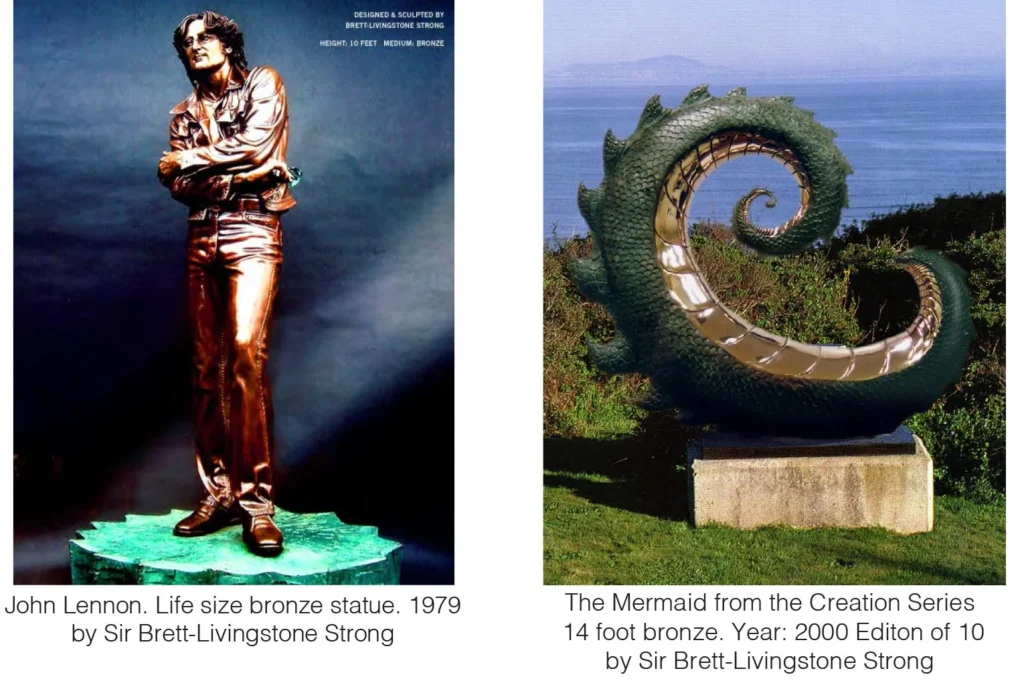
The John Lennon bronze came next. Strong’s 1979 life-size bronze statue of John Lennon, entitled “Imagine,” was created as a tribute to the former Beatle and, according to his official gallery, toured the world after Lennon’s death in 1980, was placed in New York’s Central Park at Andy Warhol’s urging, and was also shown at the Grammy Awards headquarters in Los Angeles. The pattern is clear: Strong was building a practice around large, public, celebrity-linked sculptures that could be sold, exhibited, and talked about at a scale few other artists attempted.
His public and civic commissions then multiplied. In 1984 he produced official artwork for the Los Angeles Olympic Games, and Los Angeles Mayor Tom Bradley unveiled his sculptural celebration of the city’s sisterhood with Nagoya, Japan. In 1987, President Ronald Reagan unveiled and dedicated Strong’s 27-ton Monument for the Bicentennial of the United States Constitution at Independence Hall, a commission that had come from Chief Justice Warren E. Burger.
He also worked on monumental sculptures commemorating NASA for the Smithsonian Air and Space Museum, the vision of Walt Disney, the 2000 Olympic Games in Sydney, and the 500th anniversary of Michelangelo’s David. By the time he returned to Australia in 1988 as the country’s Official Artist of the Bicentennial, his official gallery states that his public works were among the most valuable in the world. That claim is promotional in tone, but the list of commissions behind it is real and unusually prestigious for a living artist.
Portrait commissions formed the other half of his practice. His private collectors have ranged from heads of state to royalty, and portrait commissions have included Prince Charles, Princess Diana in 1986, Dr. Armand Hammer in 1987, and Michael Jackson. Rupert Murdoch, Elizabeth Taylor, Bob Hope, Lawrence Welk, Muhammad Ali, and the band U2 have also done business with the artist, according to his official gallery. Each of these names matters for his earnings, because portrait commissions from such patrons are typically priced far above ordinary gallery work, and they bring repeat business, referrals, and limited-edition sales. Strong’s gallery also states that every limited edition he has created has sold out upon release.
Strong’s career also touched popular music in a way that surprises many readers. His painting “Homage a Henri Rousseau” is reported to have become the cover artwork for Fleetwood Mac’s album “Tango in the Night” in the mid-1980s.
Album cover work, stage and set designs, and architectural designs formed a steady sideline to his monumental sculpture, and they show an artist who was willing to work across media rather than waiting for the next great commission. Like Bilmuri, another artist who built a career independently outside the usual industry machinery, Strong’s path depended on direct relationships with patrons and audiences rather than on a single employer or label. That independence brought freedom, but it also brought risk, as the next sections show. A similar blend of visual art and entertainment also runs through the career of fellow creator Seth MacFarlane.
The defining relationship of Strong’s career, however, was with Michael Jackson. Strong was introduced to Jackson in 1979, on two occasions, by musician Lawrence Welk and Los Angeles Mayor Tom Bradley, who recommended Strong’s sculpting abilities for city projects. The two men became friends and artistic collaborators over three decades. Jackson, himself a keen and prolific amateur artist, admired Strong’s portrait of Princess Diana and wanted Strong to paint his official portrait. In early 1989, the pair formalised their partnership as the Jackson-Strong Alliance, an agreement drawn up by Jackson’s attorney John Branca, under which each partner held a stake in the other’s art.
To mark the partnership, Jackson sat for a portrait by Strong — and also contributed to the painting himself — and later that year the original was sold to a Japanese businessman, Hiromichi Saeki, for a reported $2.1 million. That sale was widely described as a record price for a portrait by a living artist, and “The Book,” as the portrait is titled, is claimed to be the only portrait Jackson ever sat for. It reappeared for public viewing in Harlem, near the Apollo Theater, in July 2009, shortly after Jackson’s death.
The Jackson connection did not end with that portrait. Strong’s studio came to house a large collection of Jackson’s own artwork, and Strong has said that Jackson’s total output ran to some 150 to 160 pieces. In 2011, LA Weekly visited the Santa Monica Airport hangar where the collection was stored and reported that it had been valued at $900 million, a figure that immediately became one of the most quoted — and most contested — numbers in Strong’s story.
The valuation, the ownership of the works, and the terms of the Jackson-Strong Alliance have all been disputed in press coverage and in later legal proceedings, and readers should understand that a $900 million valuation of a collection is not the same as $900 million belonging to one person. It is a claim about a group of artworks, made by interested parties, in a contested context, and it has never been confirmed by an independent sale of the whole collection. Any discussion of brett livingstone strong net worth that treats the $900 million figure as his personal fortune would be badly misleading.
Earnings and Income Sources
How, then, did Brett Livingstone Strong actually earn money? His income came from an unusually wide set of art-world sources, and the mix changed dramatically over time. In his early years, income came from selling paintings and sculptures through exhibitions, including the sell-out shows of his childhood and youth in Australia. After his move to the United States, the largest single payments came from monumental commissions and high-value individual sales: the Wayne boulder at a reported $1.13 million and “The Book” at a reported $2.1 million are the two best-documented examples, and both were exceptional prices for their time.
Portrait commissions were a second major stream. A portrait for a head of state, a royal, or a major business figure is priced not only for the artist’s time and materials but for the prestige of the commission itself, and Strong’s client list suggests he was operating at the top of that market. Limited editions formed a third stream: his gallery reports that every limited edition sold out on release, and limited editions — prints and smaller castings sold in numbered runs — can generate substantial revenue without the artist having to part with an original painting.
A fourth stream came from design work: album covers, stage and set designs, architectural designs, and public monument projects, each paid on a commission or fee basis. A fifth, later stream came from the Jackson-Strong Alliance itself, including exhibitions, sales of Jackson-related artworks and prints, and the long-running effort to build a Michael Jackson memorial monument, a 12-foot bronze statue co-designed with Jackson in the early 1990s and endorsed by Jackson’s mother, Katherine Jackson, after his death.
What is missing from this picture is almost as important as what is present. There is no public record of Strong drawing a regular salary from an employer, selling a company, receiving a large inheritance, or earning royalties at the scale of a pop star or a bestselling author.
His earnings were project-based and lumpy: very large payments in some years, and long, expensive development periods in others, particularly on the City of Angels Monument, where years of design, engineering, and promotion work had to be funded before any revenue arrived. That lumpiness is central to brett livingstone strong net worth, because a career of big sales followed by big project costs does not accumulate wealth in the same way as a steady high salary. It can produce spectacular gross figures and a modest net position at the same time.
It is also worth comparing his model with other independent creative careers. The economics of a monumental sculptor resemble those of an independent musician or filmmaker more than those of a salaried professional: the artist fronts the costs, carries the risk, and is paid when a patron or buyer commits. Readers interested in how another independent artist built a sustainable career outside the mainstream system may find the story of Adam Zucker a useful comparison, since it shows the same trade-off between creative control and financial unpredictability. For Strong, that trade-off was extreme, because his projects were among the largest and most expensive an individual artist could attempt.
Assets and Lifestyle
When it comes to assets and lifestyle, the public record on Strong is thin, and that thin record is itself part of the brett livingstone strong net worth story. There are no widely reported, independently verified accounts of a property portfolio, a car collection, or a luxury lifestyle attached to his name in the way that celebrity wealth coverage usually provides for actors or musicians. What can be documented is the professional asset base of his career: his studio, his body of work, his limited editions, and his long-term project rights, including his stake in the Jackson-Strong Alliance and the City of Angels Monument.
The most significant asset question concerns the Jackson artwork collection. Strong has said that Jackson asked for the rights to his portion of the art to be signed over to Strong in 2008, and that the collection was stored at his Santa Monica studio and hangar.
The Jackson estate and other parties have disputed aspects of that account, and a 2026 United States bankruptcy court decision in a related adversary proceeding, concerning Brett Livingstone Strong as a discharged debtor, shows that disputes over artworks connected to the bankruptcy estate were still being litigated decades later. The court document records arguments about whether certain Michael Jackson artworks were estate property and whether a buyer had standing to claim them, and it underlines a crucial point for brett livingstone strong net worth: when ownership itself is contested, no honest writer can add the disputed collection to his personal balance sheet.
The City of Angels Monument is a similar case. Recent coverage describes it as a $2.4 billion structure, funded entirely through private patrons and the City of Angels Monument Foundation at no cost to the City of Los Angeles, with a planned unveiling on 4 September 2031, the city’s 250th anniversary. Sections of the monument, including a 36-foot angel head, are reportedly slated for exhibition during the 2028 Los Angeles Olympic Games.
But a $2.4 billion project budget is not $2.4 billion of personal wealth. It is the estimated cost of building something, to be raised from patrons, foundations, and investors, and Strong’s role is that of visionary sculptor and designer, not owner of the budget. Confusing the two is the single most common error in online discussions of brett livingstone strong net worth, and it is worth stating plainly: monument budgets belong to projects, not to people.
The same caution applies to appraisals. The 2025 appraisal of $20 million attributed to the original “1967 Tribute to Marilyn in Red” is a valuation of one painting, offered through promotional channels, not a completed sale and not cash. Appraisals can rise and fall with the market and with provenance disputes, and they say nothing about debts or taxes owed against the work. Every large number in Strong’s story should therefore be a starting point for questions — who valued it, who would buy it, and who else claims it — rather than a final answer.
For readers trying to put their own finances in perspective, the contrast is instructive. Most people’s wealth is built from steady income, savings, and a home, not from one-off sales of unique objects, and a simple net worth calculator can show how regular saving and asset growth compound over time in a way that lumpy, project-based income rarely does. Strong’s career is the opposite model: extraordinary peaks, long fallow periods, and assets whose value depends on buyers, courts, and patrons agreeing with the artist’s own view of them.
Financial Setbacks and Challenges
The most important setback in Strong’s financial story is also the best documented. In the late 1990s he proposed the City of Angels Monument, a development originally described as covering nearly 100 acres in downtown Los Angeles, with a 750-foot tower as the base for a 350-foot female angel holding a sword of light above her head.
The project absorbed eight years of package and project development, involved major firms including Gensler and the Bank of New York among its attachments, and ultimately did not go through as planned. According to published accounts, complications in Strong’s personal and professional life, together with property and contracted obligations that were not met, led to the project failing to secure its partners and alliances, and Strong filed for Chapter 11 bankruptcy protection in 2005.
That filing matters enormously for brett livingstone strong net worth. Chapter 11 is a reorganisation process, not necessarily a complete wipeout, but it is a formal acknowledgment that debts and obligations could not be met as they stood.
It sits awkwardly alongside the million-dollar sales of the 1970s and 1990s, and it explains why a man associated with such large numbers could also be described in later court documents as a discharged debtor. Wealth built from unique, illiquid artworks is fragile: a painting or sculpture may be appraised in the millions, but if it cannot be sold quickly, or if its ownership is disputed, it cannot pay a bill. The bankruptcy is the clearest evidence that Strong’s gross sales figures should never be mistaken for a net fortune.
The disputes around the Jackson collection are a second, continuing challenge. Press coverage from 2011 onwards described the collection’s ownership as contested, with the Jackson estate and Strong offering different accounts of the Jackson-Strong Alliance and of what Jackson intended. Legal proceedings connected to Strong’s bankruptcy estate were still producing court decisions in 2026, which shows how long such disputes can run and how they can prevent an artist from realising the value of work he holds. For anyone assessing his personal fortune, this is a structural problem, not a footnote: the most valuable assets associated with his name are also the most disputed.
A third challenge is reputational and commercial. Monumental projects depend on civic trust, patron confidence, and political support, and a failed project can make the next one harder to fund, even when the artistic vision remains unchanged.
Strong’s City of Angels Monument has survived in revised form — smaller in its current $2.4 billion framing than the original $3.6 billion proposal, with a new target date of 2031 and support from Los Angeles Mayor Karen Bass, who publicly congratulated him as the monument’s visionary sculptor — but the decades-long timeline itself is a cost. Time spent promoting one monument is time not spent on other commissions, and the opportunity cost of a thirty-year project is real even if it never appears on a balance sheet.
None of this diminishes Strong’s artistic achievement. Financial setbacks are common among ambitious artists, particularly those who attempt civic-scale work, and they do not erase the Wayne carving, the Lennon bronze, or “The Book.” But they do mean that brett livingstone strong net worth cannot be honestly presented as a simple success story of ever-growing millions. It is a story of peaks and reversals, and any estimate that ignores the bankruptcy and the disputes is incomplete.
Timeline
Strong’s career can be followed as a sequence of bold moves, each larger than the last. His childhood in Sydney brought early exhibitions and sell-out shows, his teenage Marilyn portrait in 1967 showed an early instinct for celebrity subjects, and his 1972 museum exhibition alongside Henry Moore and his 1973 Sydney Opera House royal invitation commission gave him national recognition while he was still a young man.
His move to the United States in 1977 brought the Wayne boulder, which made him famous in America, followed in the late 1970s and 1980s by the Lennon bronze, the introduction to Michael Jackson, the Los Angeles Olympics work, the Nagoya sister-city sculpture, the portraits of Diana and Hammer, and the Reagan dedication of the Constitution monument. The 1988 Australian Bicentennial role brought him home in triumph, and the 1989 Jackson-Strong Alliance and the 1990 sale of “The Book” seemed to confirm him as an artist who could command record prices.
The late 1990s and 2000s brought the City of Angels Monument proposal, its long development, and the 2005 bankruptcy, a reversal that reset the financial story. The 2009 knighthood recognised his charitable work, the 2011 LA Weekly story brought the Jackson collection and its disputed valuation into public view, and recent years have brought a revised City of Angels Monument, with sections planned for exhibition at the 2028 Los Angeles Olympics and a planned unveiling in 2031. Across all of this, brett livingstone strong net worth has never been a stable number, because the underlying assets, debts, and disputes have never stood still long enough to be measured.
Interesting Facts
Strong bought the rock for his John Wayne carving for just $100, after it was removed from Malibu’s Pacific Coast Highway, and the finished work reportedly sold for $1.13 million — one of the most dramatic mark-ups in modern art history, even allowing for the labour, publicity, and time involved.
He is reported to have been sponsored for his United States green card by John Wayne himself, a personal endorsement that also gave his American debut a story no publicist could have invented.
His portrait “The Book” is claimed to be the only portrait Michael Jackson ever sat for, and Jackson himself contributed to the painting, making it a collaboration as well as a portrait.
Strong trained in architecture as well as art, which helps explain why his ambitions ran to monuments and civic structures rather than only to gallery-sized work.
He was exhibiting alongside Sir Henry Moore at the age of 18, and painting the Sydney Opera House royal opening invitation at around 19.
The John Wayne boulder, renamed “Spirit of Independence,” now sits in the library of Lubbock Christian University in Texas, where visitors can see a work that began as a roadside rock in Malibu.
Strong’s Marilyn Monroe portrait, created when he was a teenager, was later endorsed by the Estate of Marilyn Monroe for a 350-piece limited edition incorporating her handprints and footprints from Grauman’s Chinese Theatre, an edition that reportedly sold out in the early 1980s.
He has a son, Stason, who has been associated with the Jackson Strong Alliance in later legal and business proceedings.
The City of Angels Monument, if completed as currently planned, is intended to stand taller than the Statue of Liberty, a deliberate echo of the ambition that has driven Strong’s career since the Wayne boulder.
Frequently Asked Questions
What is brett livingstone strong net worth in 2026?
There is no verified published figure for brett livingstone strong net worth in 2026. No major wealth publication has published a sourced estimate, and this article does not invent one. The documented numbers attached to his career are individual sale prices — a reported $1.13 million for the John Wayne carving and a reported $2.1 million for “The Book” — plus a disputed $900 million valuation claim for a Jackson artwork collection, and none of those figures equals a personal net worth.
Why is brett livingstone strong net worth so hard to estimate?
Brett livingstone strong net worth is hard to estimate because his wealth, such as it is, sits in unique artworks and project rights rather than in a salary, a listed company, or public filings. Artworks are illiquid, their ownership has been disputed in his case, and he went through Chapter 11 bankruptcy in 2005. Without access to his debts, taxes, and private holdings, any single number would be speculation.
Did Brett Livingstone Strong sell a painting for $2.1 million?
Yes, according to multiple published accounts. His portrait of Michael Jackson, “The Book,” reportedly sold for $2.1 million in 1990 to Hiromichi Saeki Corp., and the sale was widely described as a record for a portrait by a living artist. The portrait is also claimed to be the only one Jackson ever sat for.
How much did the John Wayne boulder sell for?
The John Wayne carving reportedly sold for $1.13 million, after Strong bought the Malibu rock for $100. The work, later renamed “Spirit of Independence,” now sits in the library of Lubbock Christian University in Texas. Sources differ on the boulder’s exact weight, but the sale price is consistently reported at around $1.1 million.
Is brett livingstone strong net worth $900 million?
No, there is no credible evidence for that. The $900 million figure was a valuation claim reported in 2011 for a collection of Michael Jackson’s own artwork connected to Strong, not a measurement of brett livingstone strong net worth. The collection’s ownership and value have been disputed, and a valuation is not cash, income, or a personal fortune.
What is the City of Angels Monument, and is it worth $2.4 billion?
The City of Angels Monument is Strong’s long-running proposed landmark for Los Angeles, currently described as a $2.4 billion structure with a planned unveiling on 4 September 2031. The $2.4 billion figure is the project’s estimated cost, to be funded by patrons and a foundation, not Strong’s personal wealth, and it should never be added to brett livingstone strong net worth.
Did Brett Livingstone Strong go bankrupt?
Yes. Strong filed for Chapter 11 bankruptcy protection in 2005, in connection with the City of Angels Monument project, after eight years of development did not produce the planned partnerships. Later court documents describe him as a discharged debtor, and disputes connected to the bankruptcy estate were still being litigated in 2026.
What are Brett Livingstone Strong’s most famous works?
His most famous works include the John Wayne boulder carving (“Spirit of Independence”), the life-size bronze John Lennon statue “Imagine” (1979), the Michael Jackson portrait “The Book” (1990), the 1967 “Tribute to Marilyn in Red,” the United States Constitution Bicentennial Monument (dedicated 1987), and the NASA National Space Exploration Monument for the Smithsonian.
Was Brett Livingstone Strong knighted?
Yes, in October 2009 he was made a knight of the Imperial Orders of Constantine the Great and Saint Helen, reportedly after a nomination by Debbie Rowe, in recognition of his charitable work for children. He is therefore often styled Sir Brett-Livingstone Strong.
Is Brett Livingstone Strong still working in 2026?
Yes, according to recent coverage. He remains the visionary sculptor behind the City of Angels Monument, with sections of the monument reportedly planned for exhibition during the 2028 Los Angeles Olympic Games, and new limited editions of his Marilyn Monroe portrait have been offered around Monroe’s 100th birthday in 2026.
Final Takeaway
Brett livingstone strong net worth remains, in 2026, an unanswered question in the strict sense — and that is the most honest conclusion this article can offer. There is no verified figure, and the numbers most often quoted alongside his name belong to other things: a $1.13 million sale here, a $2.1 million sale there, a disputed $900 million collection valuation, and a $2.4 billion monument budget that is a project’s cost, not a person’s fortune. To present any of those as brett livingstone strong net worth would be to confuse a price tag with a balance sheet.
What can be said with confidence is that Strong has lived one of the most extraordinary artistic lives of his generation. A child prodigy from country New South Wales exhibited alongside Henry Moore at 18, painted for a royal opening at 19, carved a Hollywood legend’s face into a Malibu boulder, cast a life-size Lennon, painted the only portrait Michael Jackson ever sat for, received a presidential dedication, and spent decades pursuing a monument intended to stand taller than the Statue of Liberty.
He has known record prices and bankruptcy, royal patrons and courtroom disputes, and his story is a reminder that artistic ambition at monumental scale carries financial risk at the same scale. More profiles that separate documented fact from rumour can be found on Worthlino.

Pingback: Big Pluto Net Worth 2025: The Shocking Truth Behind the Viral Rapper's Real Fortune - worthlino